The game loads when you press Play · press “Play Now” inside the game if it asks.
Bomb Bee
Bomb Bee
Bomb Bee: arcade Arcade
GAME INFO
How to play Bomb Bee online
Getting Started
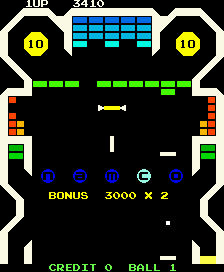
Insert a credit by pressing the Select key (V) and then press Enter (Start) to begin a game. The screen will show a formation of bricks at the top and a paddle at the bottom. Use the left and right Arrow Keys to slide the paddle horizontally, positioning it to intercept the ball as it bounces down. The objective is to clear all bricks from each stage without letting the ball fall off the bottom of the screen.
The ball travels in a straight line and bounces off walls, bricks, and your paddle. Each time you hit the ball, it may change angle slightly depending on where on the paddle it connects. Missing the ball costs you a life. The game continues until all lives are lost. Because this is a Japanese arcade release, the on-screen text and menus are entirely in Japanese, but no reading is required to play - the game is entirely action-based. Just focus on keeping the ball in play and breaking the blocks.
Bomb Bee is a pure skill game with no hidden mechanics or special attacks. The difficulty increases gradually as ball speed picks up and brick arrangements become tighter. Practice your timing and you can survive for several stages. There is no high-score save feature in the original, so write down your scores if you want to track progress.
CONTROLS
Controls
- Arrow Keys: Joystick / Movement
- X: Button 1
- S: Button 2
- Z: Button 3
- A: Button 4
- Q: Button 5
- E: Button 6
- Enter: Start / 1P
- V: Coin / Insert
Bomb Bee FAQ
Does Bomb Bee have a multiplayer or co-op mode?
Bomb Bee is a single-player arcade game. It does not include any multiplayer, cooperative, or competitive modes. The original cabinet was designed for one player at a time.
Is Bomb Bee exclusive to Arcade or did it appear on other systems?
Bomb Bee was released exclusively as an arcade game in 1979. It did not receive official ports to home consoles or computers during its era. Today, it is only playable through emulation or as part of some retro game compilations.
What type of game is Bomb Bee?
Bomb Bee is an arcade breakout-style game. The player uses a paddle to bounce a ball and break brick formations, aiming to clear each stage without losing all lives. It is a straightforward, reaction-based game typical of late 1970s arcade design.

COMMENTS (0)
No comments yet. Be the first to share your thoughts.