The game loads when you press Play · press “Play Now” inside the game if it asks.
Donkey Kong (US set 1)
Donkey Kong
Getting to Know Donkey Kong
- Arcade
- Platformer
- 5· 0 votes
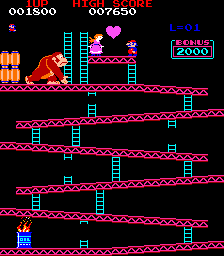
Donkey Kong is a platform game that Nintendo developed and published for arcades in 1981, here in its US set 1 version. You play as Mario, who runs, jumps and climbs ladders up a construction site to rescue Pauline from the gorilla Donkey Kong. It is the first entry in the Donkey Kong series. It is also Mario's first appearance in a video game.
Jumping matters from the start: this is the first platformer with a jump, and Mario leaps over gaps, obstacles and approaching enemies while the gorilla hurls barrels at him. There are four single-screen stages, and each one marks another 25 meters of Donkey Kong's climb, up to 100 meters. Stage one is a construction site of crooked girders and ladders where barrels and oil drums come rolling down. Stage two is a five-story stack of conveyor belts carrying cement pans, and the third stage has Mario riding elevators while springs bounce past. In the final stage he pulls out eight rivets, which brings Donkey Kong crashing down.
The story takes place in New York City, on a construction site. The hero, a carpenter, has no name in the Japanese arcade version; he was later known as Jumpman and then as Mario. Pauline was originally called Lady. At the start, the gorilla climbs two ladders to the top of the site to a variation on the theme from Dragnet, drops Pauline and stamps until the steel beams bend. When Mario clears a stage, a heart appears between him and Pauline, but the gorilla snatches her away to a higher spot and the heart breaks. The couple are reunited once the rivet stage is cleared.
Nintendo of America had 2,000 unsold Radar Scope machines in a warehouse, so its president Minoru Arakawa asked Hiroshi Yamauchi, head of the parent company, for new software to convert them. Shigeru Miyamoto made his debut as lead game designer with his Donkey Kong concept, Gunpei Yokoi supervised the project, and Ikegami Tsushinki handled most of the development as a subcontractor. Production began in January 1981.
When it reached arcades, Computer and Video Games found it compared well with King Kong. At the 1982 Arcade Awards it won best single-player video game and a Certificate of Merit as the Coin-Op Game of the Year runner-up. When the initial run of 2,000 cabinets sold out, more orders were placed. The game pulled Nintendo out of financial trouble and led Arakawa to expand Nintendo of America.
What makes it different
- Its storyline unfolds visually on screen, which makes it the earliest video game to do this, and its cutscenes tell a complete plot.
- With four distinct stages, it was the most complex arcade game of its time.
GAME INFO
- Platform
- Arcade
- Genre
- Platformer
- Publisher
- Nintendo
- Developer
- Nintendo
- Released
- 1981
- Players
- 1
- Region
- USA
- Version
- US set 1
More Donkey Kong Games
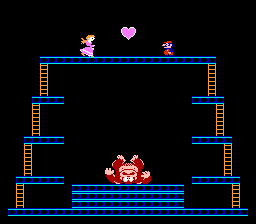
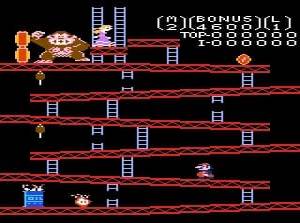
Ready for another round? Explore more Donkey Kong games and console editions. Choose a game below to play it on its own page.
How to play Donkey Kong online
You play as Mario and climb toward Pauline at the top of each screen. Jump over barrels and other hazards, or grab the hammer power-up to smash them. Mario loses a life if he falls too far, runs into Donkey Kong or an enemy object, or the bonus counter hits zero. On the rivet stage, pull out all eight rivets to bring Donkey Kong down and reunite Mario with Pauline.
Tips
- Clear each stage quickly: the bonus counter keeps dropping, and what is left of it counts toward your score.
- Pick up hats, parasols and purses along the way for extra points.
CONTROLS
Controls
- Arrow Keys — Joystick / Movement
- X — Button 1
- S — Button 2
- Z — Button 3
- A — Button 4
- Q — Button 5
- E — Button 6
- Enter — Start / 1P
- V — Coin / Insert
Donkey Kong FAQ
How many lives do you get in Donkey Kong?
You start with three lives and earn a bonus life at 7,000 points. The game ends when all lives are gone.
Why does Mario wear a cap and overalls?
The small, low-resolution sprites shaped his design. The mustache suggests a mouth, the cap saves animating hair, and the colored overalls make his arm movements easy to see. He wears red overalls and a red cap.
What was the budget for Donkey Kong?
According to Miyamoto, the project had a budget of $267,000.
What happened between Nintendo and Ikegami Tsushinki?
Ikegami claimed ownership of Donkey Kong, which led to lawsuits from both sides in 1983. Nintendo rejected the claim because Ikegami was a subcontractor that had already been paid.
You may also like
All Arcade games


GAME INFO
- Platform
- Arcade
- Genre
- Platformer
- Publisher
- Nintendo
- Developer
- Nintendo
- Released
- 1981
- Players
- 1
- Region
- USA
- Version
- US set 1
COMMENTS (0)
No comments yet. Be the first to share your thoughts.