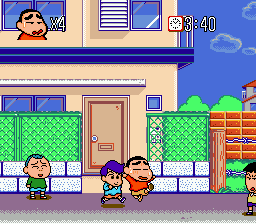
The game loads when you press Play · press “Play Now” inside the game if it asks.
Crayon Shin-chan - Arashi o Yobu Enji (Japan)
Crayon Shin-chan - Arashi o Yobu Enji
Crayon Shin-chan - Arashi o Yobu Enji on Genesis
- SEGA Genesis
- Platformer
- 5· 0 votes
Crayon Shin-chan - Arashi o Yobu Enji is an action platformer that arrived on the SEGA Genesis (Mega Drive) in 1994, exclusively in Japan. It's one of several games based on the wildly popular anime and manga series featuring the mischievous kindergartener. This particular version was developed and published by Bandai, though the exact studio behind the code isn't widely documented. It also saw a simultaneous release on the Super Famicom, but the Mega Drive edition stands as a unique port tailored to that hardware's capabilities.
The core loop is straightforward: you control Shinnosuke Nohara through side-scrolling stages filled with enemies, obstacles, and collectible items. Shinnosuke can run, jump, and attack using his trademark fart move or a toy sword, depending on power-ups. Each level is themed after locations from the show, like the neighborhood or school, and ends with a boss fight against characters from the series. The controls are responsive and the difficulty ramps up gradually, though the game is relatively short compared to other platformers of the era.
For retro collectors, this is a fun curio that captures the chaotic energy of the source material without pretending to be a masterpiece. It's one of the few anime-licensed games on the Mega Drive that actually plays decently, and it offers a glimpse into how Japanese developers handled licensed properties in the 16‑bit days. If you're a fan of Shinnosuke or just curious about obscure platformers, it's worth a quick play through. Just be ready for menus entirely in Japanese and a few quirky difficulty spikes.
GAME INFO
- Platform
- SEGA Genesis
- Genre
- Platformer
- Released
- 1994
- Players
- 1
- Region
- Japan
How to play Crayon Shin-chan - Arashi o Yobu Enji online
Getting Started
When you boot up the game you'll see a title screen in Japanese. Press Enter to start, then use the D‑Pad to select a save slot or begin a new game. The menu options are typical: はじめから (new game) and つづきから (continue). If you don't read Japanese, just pick the top option.
Once in the game, you move Shinnosuke left and right with the Arrow Keys, jump with X, and attack with S. Each stage scrolls automatically or requires you to advance to the right. You'll encounter enemies that can be stomped on or defeated with your attack. Collect food and items to regain health or earn points. The goal is to reach the end of the level and defeat the boss.
The game is fairly linear but watch out for bottomless pits and spikes. Power‑up boxes let you swap weapons - the fart attack has short range but can hit enemies above you, while the toy sword reaches farther. Use the appropriate tool for each enemy. Since the text is all in Japanese, you might need to experiment with item effects, but the core platforming action is intuitive enough to play without reading.
CONTROLS
Controls
- Arrow Keys: D-Pad / Movement
- X: A button
- S: B button
- Z: C button
- A: X button (6-button pad)
- Q: Y button (6-button pad)
- E: Z button (6-button pad)
- Enter: Start / Mode
Crayon Shin-chan - Arashi o Yobu Enji FAQ
Is Crayon Shin-chan - Arashi o Yobu Enji an official release, a fan hack, a prototype, or another kind of build?
It's an official commercial release from 1994, published by Bandai exclusively in Japan for both the SEGA Genesis and Super Famicom. No hacking or modding involved.
Roughly how long does it take to finish Crayon Shin-chan - Arashi o Yobu Enji?
A typical playthrough runs about one to two hours, depending on your familiarity with the levels and bosses. It's a short platformer by 16‑bit standards.
Is Crayon Shin-chan - Arashi o Yobu Enji exclusive to SEGA Genesis or did it appear on other systems?
It also came out on the Super Famicom under the same title, so it's not a Genesis exclusive. Both versions were released around the same time in 1994.
You may also like
All SEGA Genesis games
GAME INFO
- Platform
- SEGA Genesis
- Genre
- Platformer
- Released
- 1994
- Players
- 1
- Region
- Japan
COMMENTS (0)
No comments yet. Be the first to share your thoughts.