
The game loads when you press Play · press “Play Now” inside the game if it asks.
Dig Dug
Dig Dug
Getting to Know Dig Dug
This is the MSX version of Dig Dug, the maze game Namco developed and published for arcades. The MSX release came out in Japan in 1984.
You play as Dig Dug, also known as Taizo Hori, tunneling underground to wipe out every enemy in a stage. Pookas are round red creatures in oversized goggles, and Fygars are dragon-like and breathe fire. Dig Dug stops and shoots the end of his air pump forward; once it hooks an enemy, the enemy freezes, and repeated presses of the pump button blow it up until it bursts. Moving or waiting too long makes the pump let go, and the enemy shrinks back down while staying stunned. Rocks cannot be dug through, but when Dig Dug clears the tile beneath one and steps away, it falls a moment later and can crush enemies, or Dig Dug himself. Squashing several enemies with one rock earns bonus points, and dropping two rocks in a stage brings out a bonus item that is worth more the further you get. Enemies can drift through the dirt as ghostly eyes, slow, harmless and invulnerable until they reach open space. As their numbers fall the survivors get faster and more aggressive, and the last one tries to escape off the top of the screen.
Masahisa Ikegami planned and designed the game in 1981 with help from Galaga creator Shigeru Yokoyama. Shigeichi Ishimura, Shouichi Fukatani and Toshio Sakai programmed it for Namco's Galaga arcade board, and Namco graphic artist Ono, nicknamed Mr. Dotman, designed the sprites. Namco's marketing called it a "strategic digging game".
The arcade original launched in Japan on February 20, 1982, and Atari, Inc. released it in North America that April. Japanese home versions followed: the PV-1000 release arrived in 1983, the MSX one in 1984 and the Famicom one on June 4, 1985.
Dig Dug succeeded critically and commercially in arcades, and reviewers praised the layered strategy and the gameplay. In Japan it ranked as the second highest-grossing arcade game of that year, after Namco's Pole Position. In 1998 the Japanese magazine Gamest placed it among the greatest arcade games ever, citing how addictive it is and how it broke from the dot-eater play of Pac-Man and Rally-X.
GAME INFO
More Dig Dug Games
Ready for another round? Explore more Dig Dug games and console editions. Choose a game below to play it on its own page.
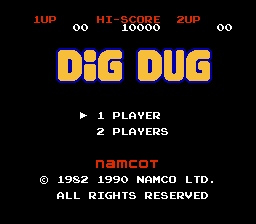
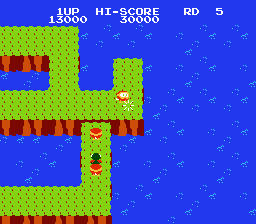
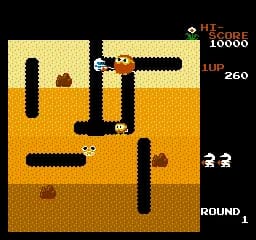
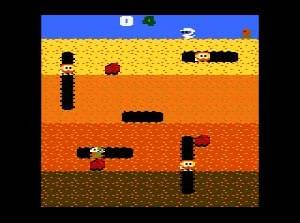
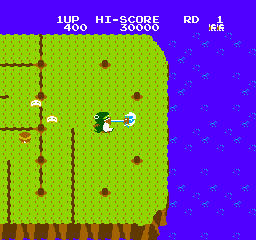
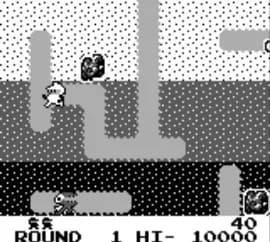
How to play Dig Dug online
Dig tunnels as Dig Dug and clear out all the Pookas and Fygars to move on to the next stage. Fire the air pump to latch onto an enemy, then keep pressing the button to inflate it until it pops. To use a rock, dig out the tile under it and step aside so it drops on the enemies below, and keep out of its path yourself.
Tips
- Line up several enemies under one rock: squashing more than one at once pays bonus points.
- Drop two rocks in a stage to make a bonus item appear, then eat it for points.
CONTROLS
Controls
- Arrow Keys — D-Pad / Movement
- X — Trigger 1
- S — Trigger 2
- Enter — Start
Dig Dug FAQ
Who composed the music for Dig Dug?
Yuriko Keino, in her first video game project. She could not make a realistic footstep sound for Dig Dug's movement, so she wrote a short melody instead.
How many Dig Dug arcade cabinets were sold?
Atari sold 22,228 cabinets in North America by the end of 1982, worth $46,300,000 in sales.
What did the designers want to do differently from Pac-Man?
They hoped the player could shape the maze by digging, in contrast to the pre-set mazes of Pac-Man (1980).
Can enemies pass through the dirt?
Yes. They move through it as ghostly eyes, either to reach Dig Dug or, as the last enemy, to escape, and they turn solid again once they reach an empty space.


COMMENTS (0)
No comments yet. Be the first to share your thoughts.