CHOOSE A VERSION
2 versions · same consoleChoose an original release, regional version, revision, bootleg or clearly labelled ROM hack/mod, then press Play. Hacks may change the gameplay. Switching versions restarts the player.
Selected: Default · Japan · Japan
The game loads when you press Play · press “Play Now” inside the game if it asks.
Fatman (Japan)
Fatman
Fatman - Fighting Classic
- SEGA Genesis
- Fighting
- 5· 0 votes
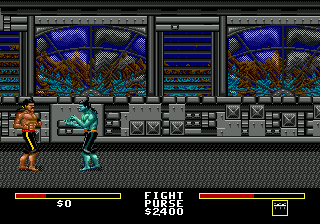
You control a large, tongue-lashing character who moves left and right across flat arenas, facing off against a series of opponents. The core loop involves closing in on enemies, landing punches or using your elongated tongue as a weapon, and avoiding their attacks. Each fight plays out in real time with simple movement and two-button controls - one for attack, one for jump or run. The side-scrolling element means you can sometimes back away or chase fleeing foes, but the focus remains on close-quarters combat. There are no complex combos; success depends on timing and spacing.
Fatman is a curiosity today because of its bizarre concept and place in early Genesis history. It is not a polished or deep fighter - think of it as a quirky arcade-style brawler that stands out for its weirdness rather than its quality. For collectors and fans of obscure Japanese releases, this ROM offers a glimpse into how developers experimented with the fighting genre on 16-bit hardware. It is short and rough around the edges, but that also gives it a certain retro charm worth checking out if you enjoy forgotten oddities.
GAME INFO
- Platform
- SEGA Genesis
- Genre
- Fighting
- Publisher
- Activision
- Developer
- MindSpan
- Released
- 1989
- Region
- Japan
How to play Fatman online
Getting started: When you boot up Fatman (Japan), you will see a title screen with Japanese text. Press Start to move to a menu screen where you can choose options like one-player game or two-player versus mode. Since the menus are entirely in Japanese, look for the first option (usually at the top) to start a single-player campaign. There is no language toggle, so you may need to experiment or rely on muscle memory to navigate.
The game drops you into a side-scrolling arena facing an opponent. Your main goal is to defeat each enemy by reducing their health bar to zero using your punches and tongue attacks. Move with the D-Pad, press the B button (S key) to attack, and use the A button (X key) to jump. You can also run by double-tapping the D-Pad in one direction. The fighting is straightforward: land hits, avoid taking damage, and move to the next stage after each victory.
A few tips: keep your distance and time your tongue strike, as it has longer range than your fists. Watch enemy patterns - they usually lunge or pause before attacking. If you get hit, you may be knocked back, so try to stay in control of the center of the screen. There are no continues or saves, so winning requires patience and pattern recognition. If you die, you restart from the beginning.
CONTROLS
Controls
- Arrow Keys: D-Pad / Movement
- X: A button
- S: B button
- Z: C button
- A: X button (6-button pad)
- Q: Y button (6-button pad)
- E: Z button (6-button pad)
- Enter: Start / Mode
Fatman FAQ
Who developed Fatman?
The developer of Fatman is not widely documented; no official studio is consistently credited for this title. It likely originated from a small team or third-party developer during the early Genesis era.
Does Fatman have a multiplayer or co-op mode?
It is uncertain whether Fatman includes a multiplayer or co-op mode. The Japanese version may have a two-player versus option, but reliable confirmation is lacking.
Is Fatman exclusive to SEGA Genesis or did it appear on other systems?
Fatman appeared on multiple platforms. The same game, known as Tongue of the Fatman, also released on the PC and Commodore 64 in 1989, meaning it is not exclusive to the SEGA Genesis.
You may also like
All SEGA Genesis games





GAME INFO
- Platform
- SEGA Genesis
- Genre
- Fighting
- Publisher
- Activision
- Developer
- MindSpan
- Released
- 1989
- Region
- Japan
COMMENTS (0)
No comments yet. Be the first to share your thoughts.