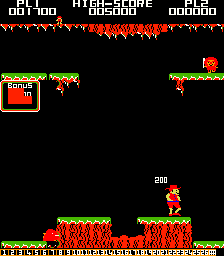
The game loads when you press Play · press “Play Now” inside the game if it asks.
Bongo
Bongo
Getting to Know Bongo
- Arcade
- Platformer
- 5· 0 votes
You control a hunter moving in four directions across an angled, 3D-looking playspace. The goal in each stage is to reach the exit, often after climbing up or down ledges, avoiding obstacles like rolling logs, puddles of water, and hostile animals. The isometric viewpoint makes depth judgment tricky - the same challenge that gave Zaxxon its reputation. The controls are simple: a joystick for movement and a single button to jump. You have a limited number of lives, and touching an enemy or hazard costs one.
Today Bongo stands out for its early use of an isometric view in a platformer, a style that was still uncommon in 1983. It's a solid but tough arcade challenge that rewards patience and precise movement. Home ports appeared on systems like the ColecoVision, Atari 2600, and even the Sega SG-1000, but the arcade original retains the crisp visuals and responsive feel. If you enjoy other isometric arcade games or classic single-screen platformers, Bongo is worth a few credits.
GAME INFO
- Platform
- Arcade
- Genre
- Platformer
- Publisher
- Sega
- Developer
- Ikegami Tsushinki
- Released
- 1983
- Players
- 1
- Region
- Worldwide
How to play Bongo online
Getting Started
When you start Bongo, the game immediately drops you into the first level. There is no title screen or menu - the action begins instantly, as was common for many arcade games of the era. Your character, a hunter, appears on the left side of an isometric stage. The objective is to reach the exit point on the right or at a higher elevation. Move using the joystick and jump over obstacles and enemies.
The core loop is simple: survive each single-screen level by avoiding all hazards. Enemies include snakes, crocodiles, and other animals that patrol set paths. The isometric perspective can make distance and height confusing - an enemy that looks far away may actually be right next to you. Take your time and study enemy patterns before moving. Jumping is your only defense, so use it to clear gaps and evade threats.
Pay attention to the climbing mechanics: some levels have ladders or ramps that let you ascend to upper platforms. Falling into water or touching enemies costs a life. You start with three lives, and there are no continues in the arcade version. The game speed picks up as you progress, so early levels are good for learning the controls and perspective. If you get stuck, note that the isometric grid means diagonal movement is often more efficient than straight cardinal moves.
CONTROLS
Controls
- Arrow Keys: Joystick / Movement
- X: Button 1
- S: Button 2
- Z: Button 3
- A: Button 4
- Q: Button 5
- E: Button 6
- Enter: Start / 1P
- V: Coin / Insert
Bongo FAQ
Is Bongo considered easy to pick up or challenging?
The controls are basic - move and jump - but the isometric viewpoint makes depth perception difficult, and enemies move in patterns that require careful timing. Most players find it punishingly hard, especially after the first few levels, though the initial stages let you get a feel for the perspective.
Is Bongo exclusive to Arcade or did it appear on other systems?
Bongo received numerous home ports soon after its arcade release. It was converted to platforms like the ColecoVision, Atari 2600, Atari 5200, and the Sega SG-1000, among others. Each port had its own visual adjustments, but the arcade original remains the reference version.
Is there anything iconic or memorable about Bongo?
The isometric view, unusual for a platformer in 1983, is its most distinguishing feature. It is also one of the few arcade games where you play a hunter chasing a gorilla, and the non-scrolling, single-screen levels give it a puzzle-like feel. The alternate title Tip Top is sometimes used in certain regions, adding to its trivia value.
You may also like
All Arcade games


GAME INFO
- Platform
- Arcade
- Genre
- Platformer
- Publisher
- Sega
- Developer
- Ikegami Tsushinki
- Released
- 1983
- Players
- 1
- Region
- Worldwide
COMMENTS (0)
No comments yet. Be the first to share your thoughts.