
The game loads when you press Play · press “Play Now” inside the game if it asks.
Mr. Do
Mr. Do
Mr. Do - Arcade Classic
GAME INFO
How to play Mr. Do online
Mr. Do controls with the arrow keys for movement. The core action involves digging tunnels through dirt to collect cherries while avoiding enemies. Mr. Do can also use a bouncing ball that he carries to defeat enemies, but the ball must be used strategically as it can be lost if thrown poorly. The game progresses in levels, with each level having a set number of cherries to collect before the next stage begins.
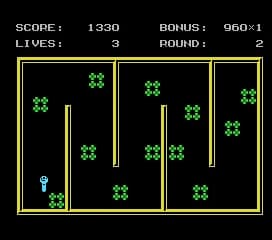
When starting, the player appears in a maze-like field of dirt. The goal is to collect all the cherries on the screen. Enemies like the red creatures and the big blue giant will chase Mr. Do. Digging tunnels can trap or slow enemies, but they can also dig themselves. The ball can be thrown to defeat enemies, but it bounces off walls and can be caught again. Players should learn the timing of the ball and the movement patterns of enemies to survive.
This is a single-player game with no save function, typical of arcade ports from this era. The menus are in English, making navigation straightforward. The game is a direct port of the arcade original, so the mechanics are faithful to the 1982 version.
CONTROLS
Controls
- Arrow Keys: D-Pad / Movement
- X: Trigger 1
- S: Trigger 2
- Enter: Start
Mr. Do FAQ
Does Mr. Do have a multiplayer or co-op mode?
Mr. Do is strictly a single-player experience. There is no multiplayer or cooperative mode in this version, as it remains true to the original arcade design where only one player plays at a time.
Can players save progress in Mr. Do?
No save functionality exists in Mr. Do. Like most arcade ports of its era, progress is not retained between sessions; the game must be completed in a single playthrough without saving.
Is Mr. Do exclusive to MSX 1 or did it appear on other systems?
Mr. Do appeared on many platforms beyond the MSX 1. It was originally released in arcades in 1982 and was ported to systems such as the Apple II, Atari 2600, Commodore 64, and various Japanese home computers, making it widely available across different hardware.


COMMENTS (0)
No comments yet. Be the first to share your thoughts.