🔊 Tap Play, then press “Play Now”
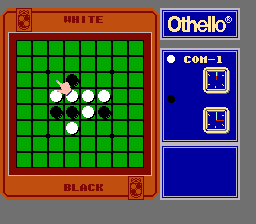
Othello (Japan) (DV 3, 5) (Disk Writer)
Othello (Japan) (DV 3, 5) (Disk Writer) Overview
Othello (Japan) (DV 3, 5) (Disk Writer) is a Famicom Disk System adaptation of the classic abstract strategy board game Reversi. Released exclusively in Japan in 1986, this version was distributed through Nintendo's Disk Writer kiosks, where players could rewrite their game disks with new titles or updated builds. The "DV 3, 5" in the title likely refers to a specific software revision or build number associated with that kiosk system. Nintendo handled both the publishing and development, bringing one of the most enduring two-player strategy games to Japan's disk-based Famicom add-on.
The gameplay follows the standard rules of Othello. Two players take turns placing one of their colored discs on an 8x8 board, with the goal of having the majority of discs showing their color when the board is full. Each move must be placed adjacent to an opponent's disc and create a straight line (horizontal, vertical, or diagonal) that sandwiches the opponent's pieces between the new disc and an existing friendly disc. All sandwiched discs then flip to the player's color. If a player has no legal moves, they pass the turn. Matches continue until neither player can move, at which point the player with the most discs on the board wins. The FDS version likely includes a single-player mode against computer AI and a two-player local mode, though the specific options are not well documented beyond the core board game mechanics.
For retro gamers and strategy enthusiasts, this Othello release is a solid, no-frills implementation of a timeless game. It holds up well for quick matches and serves as a good example of how early FDS titles adapted established board games to a digital format. The Disk Writer version adds a layer of historical curiosity, since it represents one of the many titles distributed through Nintendo's innovative but short-lived disk rewriting service. While it lacks the flashy extras of later adaptations, its clean presentation and faithful rules make it worth a few rounds on emulator today, especially if you appreciate the purity of abstract strategy.
The gameplay follows the standard rules of Othello. Two players take turns placing one of their colored discs on an 8x8 board, with the goal of having the majority of discs showing their color when the board is full. Each move must be placed adjacent to an opponent's disc and create a straight line (horizontal, vertical, or diagonal) that sandwiches the opponent's pieces between the new disc and an existing friendly disc. All sandwiched discs then flip to the player's color. If a player has no legal moves, they pass the turn. Matches continue until neither player can move, at which point the player with the most discs on the board wins. The FDS version likely includes a single-player mode against computer AI and a two-player local mode, though the specific options are not well documented beyond the core board game mechanics.
For retro gamers and strategy enthusiasts, this Othello release is a solid, no-frills implementation of a timeless game. It holds up well for quick matches and serves as a good example of how early FDS titles adapted established board games to a digital format. The Disk Writer version adds a layer of historical curiosity, since it represents one of the many titles distributed through Nintendo's innovative but short-lived disk rewriting service. While it lacks the flashy extras of later adaptations, its clean presentation and faithful rules make it worth a few rounds on emulator today, especially if you appreciate the purity of abstract strategy.
How to Play Othello (Japan) (DV 3, 5) (Disk Writer) Online
Getting Started
When you boot up Othello on the FDS emulator, the title screen appears in Japanese. Press the Start button (Enter) to proceed to the menu. The menu options are likely "1 Player" (single-player vs computer) and "2 Players" (local multiplayer). Use the D-Pad to highlight your choice and press the A button (X) to confirm. If you choose 1 Player, you will probably be asked to select a difficulty level; lower numbers usually mean an easier AI. For 2 Players, both human players take turns on the same keyboard or controller.
The core gameplay loop is exactly like a physical Othello set. On each turn, use the D-Pad to move a cursor over the empty squares on the board. Press the A button to place your disc at the highlighted square. The game automatically flips any opponent discs that are caught between your new disc and your existing discs. After your move, the turn passes to your opponent. If you have no legal moves, press the B button (S) to pass, and the computer or other player will move again. The game ends when the entire board is filled or neither player can place a disc. A screen will then display the final score and announce the winner. Since all text is in Japanese, recognizing game-over prompts may require some trial and error, but the gameplay is entirely visual and easy to pick up.
When you boot up Othello on the FDS emulator, the title screen appears in Japanese. Press the Start button (Enter) to proceed to the menu. The menu options are likely "1 Player" (single-player vs computer) and "2 Players" (local multiplayer). Use the D-Pad to highlight your choice and press the A button (X) to confirm. If you choose 1 Player, you will probably be asked to select a difficulty level; lower numbers usually mean an easier AI. For 2 Players, both human players take turns on the same keyboard or controller.
The core gameplay loop is exactly like a physical Othello set. On each turn, use the D-Pad to move a cursor over the empty squares on the board. Press the A button to place your disc at the highlighted square. The game automatically flips any opponent discs that are caught between your new disc and your existing discs. After your move, the turn passes to your opponent. If you have no legal moves, press the B button (S) to pass, and the computer or other player will move again. The game ends when the entire board is filled or neither player can place a disc. A screen will then display the final score and announce the winner. Since all text is in Japanese, recognizing game-over prompts may require some trial and error, but the gameplay is entirely visual and easy to pick up.
Othello (Japan) (DV 3, 5) (Disk Writer) Keyboard Controls
Controls
- Arrow Keys: D-Pad / Movement
- X: A button (jump / confirm)
- S: B button (run / attack / cancel)
- Enter: Start / Pause
- V: Select
Frequently Asked Questions
Who developed Othello?
Othello for the Famicom Disk System was developed and published by Nintendo. It was released in Japan in 1986 as one of the early titles for the FDS platform.
Is Othello exclusive to Famicom Disk System or did it appear on other systems?
While this specific version is for the FDS, the game Othello was also released on the Nintendo Entertainment System (NES) in 1988 and on other platforms like the Game Boy in later years. The FDS version is notable for its Disk Writer distribution method.
Does Othello have a multiplayer or co-op mode?
Yes, Othello supports a local two-player versus mode where two human players take turns on the same console. It also includes a single-player mode where you compete against a computer opponent, making it a one or two player game overall.
Comments (0)