🔊 Tap Play, then press “Play Now”

Buster Bros. (US)

0 Favorites 0 Likes 0 Views
Rate this game:
Embed Code
Buster Bros. (US)
Arcade Action Pub Capcom Dev Mitchell Corporation 1989 USA 1-2 Players 5 (0) 0

Buster Bros. (US)

Getting to Know Buster Bros. (US)

Buster Bros. is the North American title for Pang, an arcade action game from 1989. It was developed by Mitchell Corporation and published in the US by Capcom. This is the same game that came out in Japan as Pomping World and later became a beloved classic worldwide. It runs on standard arcade hardware from the late 80s, featuring simple but addictive gameplay that holds up well today.

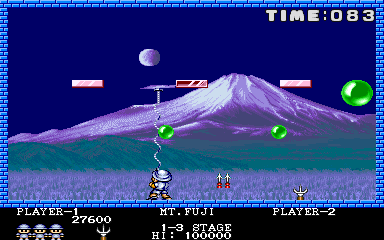
The player controls a character at the bottom of the screen, moving left and right while shooting a harpoon upward. The screen is filled with bouncing balloons that gradually descend. Hitting a balloon with your harpoon causes it to split into two smaller balloons, which then move faster and bounce more erratically. The goal is to clear all balloons on the stage without letting any touch your character. Each stage has a fixed layout of balloons, and the challenge ramps up quickly as you advance.

What makes Buster Bros. worth revisiting is its pure pick-up-and-play design. The split mechanic creates satisfying chain reactions and requires careful positioning, making it a precursor to later puzzle-shooter hybrids. It supports two-player co-op, which adds chaos and fun. While it's a simple concept, the escalating speed and balloon count keep the tension high. If you enjoy arcade games that test precision and timing without complicated controls, this one is a gem from Capcom's 1989 library.

How to Play Buster Bros. (US) Online

In Buster Bros., you control a small character at the bottom of the screen. Your basic objective is to shoot all the bouncing balloons that fill the playfield. Press the attack button (S by default) to fire your harpoon straight upward. Each balloon hit will split into two smaller ones; these smaller balloons move faster and bounce more frequently. You must avoid letting any balloon touch your character, or you lose a life.

The game progresses through a series of stages, each with a different arrangement of balloons. Some balloons are connected by chains - shooting the chain can clear a group at once if you time it right. After clearing all balloons, the stage ends and you move to the next, which introduces more balloons and tighter spacing. The core loop is simple: move, aim, shoot, dodge. There are no complex power-ups, just you and the bouncing balloons.

New players should remember that you can only shoot one harpoon at a time; it must return before you can fire again. Use the arrow keys to position yourself carefully. Staying near the center often gives you better coverage, but you'll need to move to the sides to catch stray balloons. Co-op play (two players) adds another character that can help clear balloons faster, but also doubles the chaos. Practice the timing of split reactions - often it's better to let a balloon come close before shooting, so the two smaller ones stay on one side.

Buster Bros. (US) Keyboard Controls

Controls

  • Arrow Keys: Joystick / Movement
  • X: Button 1
  • S: Button 2
  • Z: Button 3
  • A: Button 4
  • Q: Button 5
  • E: Button 6
  • Enter: Start / 1P
  • V: Coin / Insert

Frequently Asked Questions

What makes Buster Bros. stand out among Arcade titles of its era?
Its central hook - splitting a balloon into two smaller, faster ones with each shot - creates a unique risk-reward loop that few other arcade games attempted. The pacing ramps up naturally, and the cooperative mode turns the chaos into a shared challenge.
Roughly how long does it take to finish Buster Bros.?
A single playthrough on the default settings takes about 15 to 30 minutes for experienced players, though the difficulty increases sharply in later stages. Most arcade runs are short, designed for quarters, but the full game has over 50 levels.
Is Buster Bros. exclusive to Arcade or did it appear on other systems?
Buster Bros. saw ports to several home platforms, including the NES, TurboGrafx-16, and the Amiga. Those versions often tweak the graphics or add extra modes, but the core gameplay remains the same as the arcade original.

Comments (0)

    More Action Games