The game loads when you press Play · press “Play Now” inside the game if it asks.
Zenji
Zenji
Zenji Overview
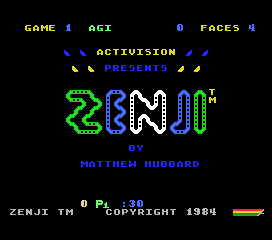
Zenji is a puzzle game released in 1984 across several home computers and consoles, including the MSX 1. It was designed by Matthew Hubbard, best known for his earlier work on Dolphin for the Atari 2600, and published by Activision. This version brings the same tile-based logic to the MSX, a system popular in Japan and Europe for its diverse library of arcade conversions and original titles. If you haven't played this before, you're in for a clean, no-frills puzzler that relies purely on spatial reasoning.
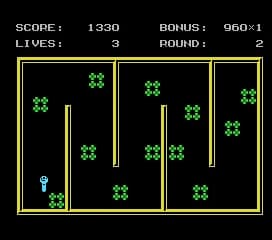
The core objective in Zenji is to rearrange hexagonal tiles on a grid so that they form a continuous closed loop. Each tile has one or more colored edges, and by rotating or swapping them, you connect matching edges. Once every piece is in place and the loop is complete, you clear the board and move to a harder layout. There's no timer, no enemies, just you and the patterns - a setup that rewards careful planning over quick reflexes. The game gradually increases the number of tiles and the complexity of the connections, keeping the challenge focused on logic.
What makes Zenji worth a look today is how it embodies the early-80s puzzle design ethos: simple rules, escalating difficulty, and no fluff. It sits alongside classics like Boulder Dash and Lode Runner as a thinking person's alternative to the action-heavy shooters of the era. On the MSX, where many puzzle games were later Japanese imports, Zenji stands out as a clean Western design that still feels satisfying to solve. If you enjoy Sokoban or Pipe Dream, this will scratch a similar itch - just be prepared for a decent challenge once the boards get crowded.
The core objective in Zenji is to rearrange hexagonal tiles on a grid so that they form a continuous closed loop. Each tile has one or more colored edges, and by rotating or swapping them, you connect matching edges. Once every piece is in place and the loop is complete, you clear the board and move to a harder layout. There's no timer, no enemies, just you and the patterns - a setup that rewards careful planning over quick reflexes. The game gradually increases the number of tiles and the complexity of the connections, keeping the challenge focused on logic.
What makes Zenji worth a look today is how it embodies the early-80s puzzle design ethos: simple rules, escalating difficulty, and no fluff. It sits alongside classics like Boulder Dash and Lode Runner as a thinking person's alternative to the action-heavy shooters of the era. On the MSX, where many puzzle games were later Japanese imports, Zenji stands out as a clean Western design that still feels satisfying to solve. If you enjoy Sokoban or Pipe Dream, this will scratch a similar itch - just be prepared for a decent challenge once the boards get crowded.
GAME INFO
- Platform
- MSX 1
- Genre
- Puzzle
- Publisher
- Activision
- Developer
- Activision
- Released
- 1984
- Players
- 1
How to play Zenji online
To get started, load the ROM in your emulator and press Enter to begin. The game presents a grid of hexagonal tiles, each with colored segments on its edges. Your goal is to rotate tiles so that matching colors form a continuous, unbroken loop. Use the Arrow Keys to move a cursor across the board and press X (the A button) to rotate a tile 60 degrees clockwise. Pressing S (B button) might let you swap tiles or cancel a selection, depending on the specific build - experiment a bit if nothing happens immediately.
Start by examining the overall shape of the puzzle. Look for edges that are already connected correctly and work outward from there. There is no time limit, so take your time to plan moves. Once you believe you've completed the loop, press Enter to check - if the loop is closed, the screen clears and you advance to the next level. If not, the game will let you know, usually with a short sound, and you can continue adjusting. The early levels are small, but later ones add many more tiles, making visual scanning and logical deduction crucial. Keep a mental image of what each tile needs to connect to, and don't hesitate to undo a rotation if you're stuck.
CONTROLS
Controls
- Arrow Keys: D-Pad / Movement
- X: Trigger 1
- S: Trigger 2
- Enter: Start
Zenji FAQ
What type of game is Zenji?
Zenji is a puzzle video game where you rotate hexagonal tiles to create a continuous colored loop. It belongs to the tile-matching and path-connection subgenre popular on 8‑bit systems.
Can players save progress in Zenji?
No, the original cartridge version does not include any save feature. Players start from the first level each time they power on the machine, as was standard for most 1984 releases.
Who developed Zenji?
The game was designed by Matthew Hubbard, who previously created Dolphin for the Atari 2600. It was published by Activision, a major third‑party publisher of the era.
You may also like
All MSX 1 games


GAME INFO
- Platform
- MSX 1
- Genre
- Puzzle
- Publisher
- Activision
- Developer
- Activision
- Released
- 1984
- Players
- 1
COMMENTS (0)
No comments yet. Be the first to share your thoughts.