The game loads when you press Play · press “Play Now” inside the game if it asks.
Puzzle Panic
Puzzle Panic
Puzzle Panic on MSX1
At its core, Puzzle Panic tasks the player with manipulating shapes or tiles on a grid to clear the screen or achieve a high score. The exact rules aren't spelled out in available records, but typical MSX puzzle games from this period involve matching colors, stacking blocks, or navigating falling pieces. The player interacts using the keyboard, pressing directional keys to move and a button to confirm actions. Without a manual, new players would need to experiment with the controls to discover the objective, a common experience for owners of imported or orphaned software. The challenge escalates as pieces fall faster or the grid fills, demanding quick thinking and pattern recognition.
Puzzle Panic is worth trying today for anyone interested in the roots of the puzzle genre on early home computers. It's not a landmark title like Tetris, but it represents the kind of simple, focused gameplay that defined many hours of gaming in the 1980s. Because information is thin, approaching it with a spirit of discovery is part of the fun. Emulating it on a site like this one preserves a fragment of MSX history that might otherwise be lost. If you enjoy no-frills puzzles with a retro feel, give it a few rounds.
GAME INFO
How to play Puzzle Panic online
Getting Started
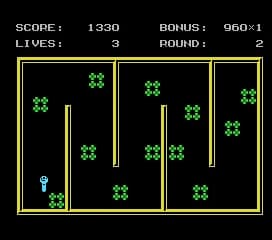
First, load the game through the emulator. If the title screen appears, press V for Select to check for options, then Enter to start a new game. The screen will likely show a grid or play area with some pieces already placed. Use the arrow keys to move a cursor or piece left, right, up, or down. Press X to confirm your placement or to select falling pieces. The core loop involves clearing blocks or matching patterns before the timer runs out or the board fills. Watch for any indicators like a rising bar or dropping pieces that increase the pressure.
If the game is in Japanese, the menus will use kanji or kana. Common commands include スタート (start), はい (yes), いいえ (no). You can usually navigate by pressing Enter to advance. Experiment with pressing X and S in combination with the arrow keys to see if actions like rotating or swapping are available. Most MSX puzzle games have a simple rule: align three or more identical symbols horizontally or vertically to make them vanish. If Puzzle Panic follows this convention, focus on setting up chain reactions to score bonus points. The game ends when the grid overflows or time expires, so aim to keep the playfield clear.
CONTROLS
Controls
- Arrow Keys: D-Pad / Movement
- X: Trigger 1
- S: Trigger 2
- Enter: Start
Puzzle Panic FAQ
Does Puzzle Panic have a multiplayer or co-op mode?
Information about multiplayer is not widely documented for this title. Based on typical MSX 1 puzzle releases, it is most likely a single-player experience. No evidence of a two-player mode has been found in available references. What makes Puzzle Panic stand out among MSX 1 titles of its era? Without a detailed manual, it is difficult to pinpoint unique features. The name suggests a focus on fast-paced action, which might distinguish it from slower, more methodical puzzle games on the platform. Its relative obscurity adds a layer of curiosity for collectors exploring the MSX library. Who developed Puzzle Panic? The developer of Puzzle Panic is not widely documented in online retro gaming databases. It may have been created by a small studio or an individual programmer, but no authoritative source confirms the name. This lack of attribution is common for budget or low-profile MSX releases.


COMMENTS (0)
No comments yet. Be the first to share your thoughts.