
The game loads when you press Play · press “Play Now” inside the game if it asks.
Genghis Khan
Genghis Khan
Inside Genghis Khan
You take on the role of a Mongol leader - Genghis Khan or another historical figure - and manage your tribe's economy, military, and diplomacy. The core loop involves moving armies across a map of Asia, conquering cities, and negotiating with rival factions. Battles are resolved through turn-based tactical combat on a grid, where unit positioning and formations matter. Resource management and family succession also play a part, as you must ensure your dynasty lasts.
For retro strategy fans, this MSX1 version is a compact but deep example of Koei's early work. It lacks the graphical polish of later 16-bit ports but retains the same satisfying complexity. If you enjoy slow-burn conquest games like Nobunaga's Ambition, this is worth a look - though prepare for Japanese menus and a steep learning curve. It's a niche title even among retro enthusiasts, but that's part of its charm.
GAME INFO
More Genghis Khan Games
Ready for another round? Explore more Genghis Khan games and console editions. Choose a game below to play it on its own page.
How to play Genghis Khan online
Getting started: This is a Japanese-only title, so menus are entirely in kanji and kana. When you start, you'll see a title screen and then a main menu with options like "始める" (start) and "ロード" (load). Use the Arrow Keys to navigate, press X to confirm, and S to cancel. Begin a new game by selecting the first option.
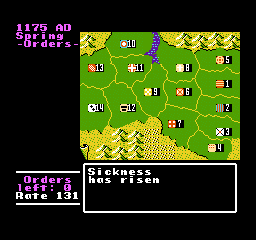
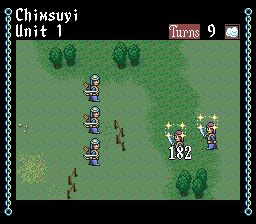
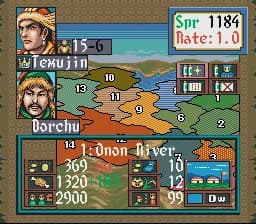
The game presents a large map of East Asia divided into provinces. You control a nomadic tribe - typically the Mongols under Genghis Khan. Each turn you can issue orders: move armies, build units, manage food and gold, or send diplomats. Combat happens when two armies meet on the map; you'll be taken to a tactical battle screen where you position units and attack. The goal is to unify all provinces under your rule.
New players should focus on building a strong economy first: recruit herders and upgrade pastures to boost food production. Avoid overexpanding early; keep your army size manageable until you have a solid resource base. Use the save option (セーブ) often. If you get stuck, look for fan-translated manuals online - the in-game text is dense and can be confusing without some guidance.
CONTROLS
Controls
- Arrow Keys: D-Pad / Movement
- X: Trigger 1
- S: Trigger 2
- Enter: Start
Genghis Khan FAQ
Who developed Genghis Khan?
Koei developed the game, handling both design and programming for the MSX1 port. The original PC-98 version was also by Koei, known for historical simulation series.
Is Genghis Khan an official release, a fan hack, a prototype, or another kind of build?
This is an official commercial release from Koei, originally sold in Japan on the MSX1 in 1988. It is not a hack, prototype, or fan work.
Is there anything iconic or memorable about Genghis Khan?
The Japanese title translates to "Blue Wolf and White Hind: Genghis Khan," referencing a Mongol founding myth. It is one of the earlier turn-based strategy games to simulate Asian conquest on a grand scale, predating many Western equivalents.


COMMENTS (0)
No comments yet. Be the first to share your thoughts.