History · 7 min read
From Pong to Street Fighter II: A Look Back at Arcades
From Pong to packed fighting-game nights, a look back at life around the cabinets.
In this guide · 5 sections
Every console game you love owes a debt to a dark room full of glowing cabinets and the smell of warm electronics. The arcade was where video games grew up in public, and its story is the story of the medium itself. Here is the short version.
The spark: Pong and the early 1970s
The arcade video game boom effectively begins with Pong in 1972 — the first big commercial hit, a year after Computer Space. It was almost absurdly simple — two paddles and a ball — but it was social, competitive, and it made money. That last part mattered: it proved there was a business in coin-operated play, and a whole industry rushed in.
The golden age: invaders, dots, and chaos
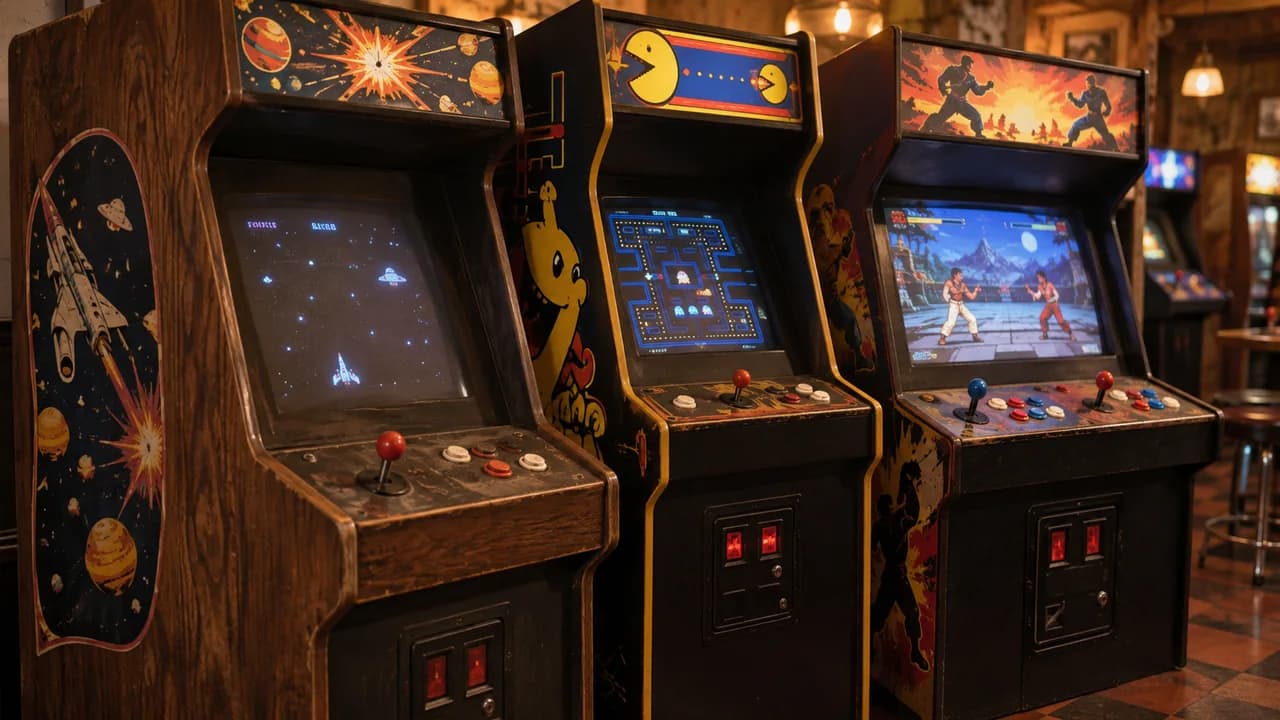
The late 1970s and early 1980s were an explosion. Space Invaders turned games into a cultural phenomenon and reportedly caused coin shortages. Pac-Man broadened the audience beyond young men, becoming a genuine pop-culture icon. Donkey Kong introduced a character named Jumpman who would soon be known as Mario. Arcades became social hubs, and the high-score table turned strangers into rivals.
The crash and the comeback
The market overheated and a downturn hit the broader industry in the mid-1980s. But the arcade did not die — it adapted. As home consoles improved, arcades survived by offering what living rooms could not: bigger, louder, more powerful hardware and experiences you simply could not get at home.
The second golden age: the fighting boom
Then, in the early 1990s, Street Fighter II changed everything again. Suddenly the draw was not a high score but the player standing next to you. Competitive fighting games turned arcades into arenas, and a generation learned that the most intense rival a game could offer was another human being. Beat-'em-ups, light-gun games, and racers kept the cabinets busy through the decade.
Why it still matters
The arcade's DNA is everywhere: in the pick-up-and-play design of the best mobile games, in the competitive scenes that fill stadiums today, and in the simple, irresistible loop of "just one more try." Many of the games that defined those rooms are playable in your browser now — and firing one up is the closest thing to stepping back into that neon glow.