CHOOSE A VERSION
2 versions · same consoleChoose an original release, regional version, revision, bootleg or clearly labelled ROM hack/mod, then press Play. Hacks may change the gameplay. Switching versions restarts the player.
Selected: Default · USA · USA
The game loads when you press Play · press “Play Now” inside the game if it asks.
Battle Arena Toshinden (USA)
Battle Arena Toshinden
Battle Arena Toshinden: GB Fighting
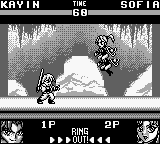
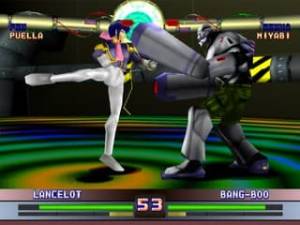
The Game Boy port of Battle Arena Toshinden arrived in 1996, bringing the PlayStation's 3D fighter to a tiny monochrome screen. Developed by Tamsoft and published by Sega in North America, this is a straightforward port that shrinks the original's polygonal brawlers into sprite-based characters. It's still a fighting game at heart, built around one-on-one matches, but the hardware forced a more blocky, side-scrolling look instead of the original's shifting camera.
You pick a fighter from a roster that includes the mainstays - Eiji, Kayin, Sophia, and others - and then jump into a series of best-of-three rounds against AI opponents or a second player via the link cable. Each character has a set of basic punches, kicks, and special moves activated by directional inputs and button presses. A burst gauge fills as you land hits; once full, you can unleash a more powerful super move. The core loop is simple: close in, land combos, manage your distance, and try to knock the other fighter down twice before they do the same to you.
This version is a curiosity more than a must-play. The sluggish controls and simplified visuals make it a distant relative of the flashy PlayStation original, but it still works as a portable arcade-style fighter. It's neat for anyone curious about how developers squeezed 3D fighters onto 8-bit hardware, and the link cable support adds a taste of local multiplayer. It's not a masterpiece, but it's a clean, honest port that does exactly what it sets out to do.
GAME INFO
- Platform
- Game Boy
- Genre
- Fighting
- Publisher
- Sony Interactive Entertainment
- Developer
- Tamsoft
- Released
- 1996
- Players
- 1-2
- Region
- USA
More Battle Arena Toshinden Games
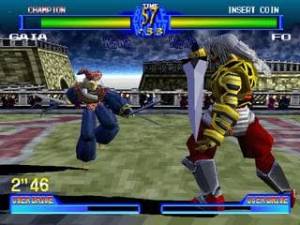
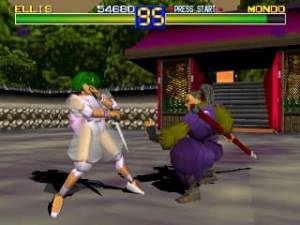
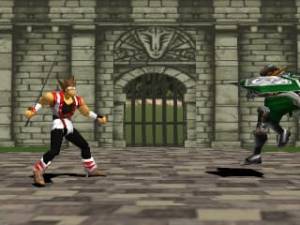
Ready for another round? Explore more Battle Arena Toshinden games and console editions. Choose a game below to play it on its own page.
How to play Battle Arena Toshinden online
Getting Started
When the title screen appears, press Start to reach the main menu. Choose "1 PLAYER" for the standard arcade mode, "2 PLAYER" for link cable versus, or "OPTIONS" to adjust sound and difficulty. The game then asks you to select a fighter from a grid of eight characters. Use the D-Pad to move the cursor and press the A button (X key) to confirm your choice. Each fighter has a unique set of special moves, but all share a similar control scheme.
Once the match starts, you and your opponent fight over the best of three rounds. The D-Pad moves your character left and right, and you can jump by pressing up. The B button (S key) performs a basic attack; holding B makes your character run toward the opponent. The A button (X key) is used for a second attack or jumping. Special moves are executed by combining directional inputs with a button press - for instance, a quarter-circle forward motion followed by B for a projectile. Experiment in practice or against weak AI to learn each fighter's move list.
The burst gauge at the bottom of the screen fills as you connect hits or block attacks. When it's full, press the Y button (Z key) to unleash a powerful super move. This can turn the tide if used wisely. The core loop is simple: find an opening, land combos, and manage your range. If you lose, you can continue by pressing A at the continue screen. Keep fighting until you either beat the final boss or run out of continues.
CONTROLS
Controls
- Arrow Keys: D-Pad / Movement
- X: A button (jump / confirm)
- S: B button (run / attack / cancel)
- Enter: Start / Pause
- V: Select
Battle Arena Toshinden FAQ
Who developed Battle Arena Toshinden?
Tamsoft developed the Game Boy version of Battle Arena Toshinden. The same studio handled the original PlayStation release and its other ports.
Is Battle Arena Toshinden exclusive to Game Boy or did it appear on other systems?
No, it originally debuted on the PlayStation and later appeared on Sega Saturn, PC, and the Game Boy. The Game Boy version is a portable downport of that earlier console hit.
What makes Battle Arena Toshinden stand out among Game Boy titles of its era?
It is one of the few direct arcade-style fighting games on the system, bringing a recognizable 3D fighter series to a 2D sprite format. The inclusion of a burst gauge, a roster of multiple characters, and link cable multiplayer were ambitious for a handheld in 1996.
You may also like
All Game Boy games
GAME INFO
- Platform
- Game Boy
- Genre
- Fighting
- Publisher
- Sony Interactive Entertainment
- Developer
- Tamsoft
- Released
- 1996
- Players
- 1-2
- Region
- USA
COMMENTS (0)
No comments yet. Be the first to share your thoughts.