The game loads when you press Play · press “Play Now” inside the game if it asks.
DX Monopoly GB (Japan)
DX Monopoly GB
DX Monopoly GB: GBC Board Game
- Game Boy Color
- Board Game
- 5· 0 votes
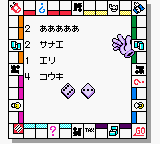
DX Monopoly GB (Japan) brings the classic Parker Brothers board game to the Game Boy Color, offering a portable version of the property-trading empire. Released exclusively in Japan, this is a straightforward adaptation of Monopoly, not a hack or fan project. Like most GBC board game ports, it places the familiar real estate and money management gameplay into a handheld format, with menus and text entirely in Japanese.
The core loop follows the traditional Monopoly rules: players roll dice, move around the board, buy properties, build houses and hotels, and collect rent from opponents. The game includes several "house rules" that can be toggled to spice up matches, such as auction rules or free parking bonuses. Matches can be played solo against AI opponents or with up to four human players via a link cable, though the AI is fairly basic by modern standards.
For fans of board game adaptations on the Game Boy Color, DX Monopoly GB is a competent but niche title. Its primary draw is the ability to play Monopoly on the go, complete with the optional rule variants that keep sessions fresh. However, the Japanese-only text means non-readers will struggle. It is a solid example of the genre, but not a must-play unless you are a dedicated collector or a Monopoly completionist.
GAME INFO
- Platform
- Game Boy Color
- Genre
- Board Game
- Players
- 1-4
- Region
- Japan
- Version
- DX
How to play DX Monopoly GB online
Getting Started
First, select a mode from the title screen. Since the game is entirely in Japanese, look for the option that starts a new game (kanji for "start" or "new") or choose a saved file if available. You will be asked to set the number of players and whether they are human or computer-controlled. Use the D-pad to navigate and the A button (X on keyboard) to confirm selections.
The core loop is the same as the board game: roll the dice by pressing the A button on your turn, move your token, and follow the space you land on - buy unowned properties, pay rent, draw Chance/Community Chest cards, or go to jail. The game automates money handling, so you only need to decide whether to buy properties or make trades when prompted. Keep an eye on the top of the screen for your cash total and property list.
Important mechanics: you can toggle house rules at the start - these appear as a list of options with checkboxes (likely using the D-pad and A button). To save, look for a save option in the menu (often the second option on the main screen). The link cable multiplayer requires two GBCs and a copy of the game each; the option is usually marked with a cable icon. Since menus are in Japanese, learning a few key kanji (like "buy" 買う, "flag" フラグ) or using a translation guide will help non-readers get the most out of this version.
CONTROLS
Controls
- Arrow Keys: D-Pad / Movement
- X: A button (jump / confirm)
- S: B button (run / attack / cancel)
- Enter: Start / Pause
- V: Select
DX Monopoly GB FAQ
Does DX Monopoly GB have a multiplayer or co-op mode?
DX Monopoly GB supports up to four players using a Game Boy Color link cable. Players can compete against each other in standard Monopoly matches, with AI opponents filling in for human slots. There is no co-op mode in the traditional sense - it is a competitive board game adaptation.
Can players save progress in DX Monopoly GB?
The game allows saving progress via battery-backed memory. Players can save at any point during a match, typically by accessing the in-game menu and selecting the save option. Saved games can be loaded from the title screen to continue a session later.
What makes DX Monopoly GB stand out among Game Boy Color titles of its era?
The inclusion of optional "house rules" - such as auction modifications or free parking bonuses - gives players flexibility beyond the standard Monopoly rules. As a Japanese exclusive, it offers a slightly different experience from Western releases, though the core gameplay remains identical. The use of the Game Boy Color's limited color palette to render the board and tokens is also a neat technical achievement for a 1999 handheld title.
You may also like
All Game Boy Color games
GAME INFO
- Platform
- Game Boy Color
- Genre
- Board Game
- Players
- 1-4
- Region
- Japan
- Version
- DX
COMMENTS (0)
No comments yet. Be the first to share your thoughts.