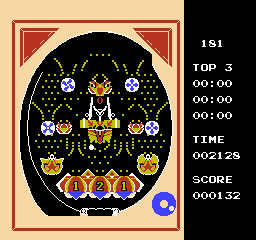
The game loads when you press Play · press “Play Now” inside the game if it asks.
Pachicom (Japan) (Disk Writer)
Pachicom
About Pachicom
- Famicom Disk System
- Simulation
- 5· 0 votes
GAME INFO
- Platform
- Famicom Disk System
- Genre
- Simulation
- Publisher
- EMI Music Japan
- Developer
- Bear's
- Released
- 1985
- Region
- Japan
How to play Pachicom online
Getting Started
When the game loads, you may see a title screen in Japanese. Press V (Select) or Enter (Start) to begin. The menu language is Japanese, but pachinko mechanics are intuitive: you launch a ball by pressing a button (likely X or S) to pull back a virtual plunger. The longer you hold, the stronger the shot. If you have multiple balls to fire, the game will prompt you to continue after each round.
Once a ball is launched, watch it cascade through pins and obstacles. Your aim is to have it land in one of the scoring pockets near the bottom. Landing in certain pockets may award bonus balls or trigger a small slot‑machine feature. There is no save system - your score tracks the current session only. The game ends when you run out of balls completely.
Because the interface is entirely in Japanese, you may need to experiment with button presses to navigate menus. In general, pressing Start after a game over will return you to the title screen. If you get stuck, try pressing V or B to cycle through options, then confirm with X. The gameplay loop is simple: launch, watch, collect balls, repeat. There is no complex story or progression to confuse you.
CONTROLS
Controls
- Arrow Keys: D-Pad / Movement
- X: A button (jump / confirm)
- S: B button (run / attack / cancel)
- Enter: Start / Pause
- V: Select
Pachicom FAQ
Is Pachicom considered easy to pick up or challenging?
Pachinko is inherently luck-based, making Pachicom simple to start - you just launch balls and watch them bounce. The challenge comes from learning the timing of the plunger and understanding which pockets are worth aiming for, but there is no steep learning curve.
Is there anything iconic or memorable about Pachicom?
As one of the few pachinko simulations released for the Famicom Disk System, its main draw is its novelty. The Disk Writer distribution method is also a notable piece of FDS history, though the gameplay itself is not particularly groundbreaking.
Is Pachicom an official release, a fan hack, a prototype, or another kind of build?
Pachicom is an official commercial release from 1985, published for the Japanese market across multiple platforms. The Famicom Disk System version is an official port, not a hack, prototype, or homebrew.
You may also like
All Famicom Disk System games Aki to Tsukasa no Fushigi no Kabe
 Yume Koujou - Doki Doki Panic
 Bishoujo Hanafuda Club Vol.2 - Koikoi Bakappana Hen
 Bishoujo Shashinkan - Studio Cut
 Bishoujo Sexy Slot
 Bishoujo Hanafuda Club Vol.1 - Oichokabu Hen
 Transformers - The Headmasters
 Bakutoushi Patton-kun
 Aliens - Alien 2
 Tenshitachi no Houkago
 Backgammon
 Chitei Tairiku Ordola
GAME INFO
- Platform
- Famicom Disk System
- Genre
- Simulation
- Publisher
- EMI Music Japan
- Developer
- Bear's
- Released
- 1985
- Region
- Japan
COMMENTS (0)
No comments yet. Be the first to share your thoughts.