🔊 Tap Play, then press “Play Now”
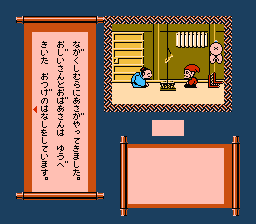
Famicom Mukashibanashi - Shin Onigashima - Zenpen (Japan) (DV 2, 3) (Disk Writer)
What is Famicom Mukashibanashi - Shin Onigashima - Zenpen (Japan) (DV 2, 3) (Disk Writer)?
Famicom Mukashibanashi - Shin Onigashima - Zenpen is a text adventure game for the Famicom Disk System, released exclusively in Japan in 1987. It is the first half of a two-part story, published by Nintendo. The game uses the FDS's disk system to store player progress via save files, which was somewhat novel at the time. This entry, marked as (DV 2, 3) (Disk Writer), refers to a specific revision distributed through disk writer kiosks where players could rewrite disks with new games at retail locations.
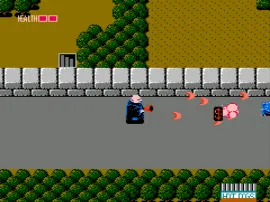
In Shin Onigashima - Zenpen, the player controls a protagonist who must explore a demon-infested island to rescue a kidnapped princess. Gameplay revolves around reading descriptive text and typing simple commands - such as "look," "take," "talk," or "go" - to interact with the environment and characters. The player navigates through locations represented by static images, solves puzzles by using items correctly, and advances the story through correct dialogue choices. It is a traditional Japanese text adventure, heavily reliant on understanding the language and folklore references.
This game stands out as one of the earlier narrative-focused titles on the Famicom Disk System, showcasing the platform's ability to deliver more complex stories than standard cartridge games. Its folklore-inspired setting, with demons and ancient Japanese mythology, gives it a distinct atmosphere that still appeals to adventure game enthusiasts today. However, because it is entirely in Japanese and lacks any translation, it is best suited for players comfortable with the language or willing to follow a guide. It remains a memorable piece of early FDS software.
In Shin Onigashima - Zenpen, the player controls a protagonist who must explore a demon-infested island to rescue a kidnapped princess. Gameplay revolves around reading descriptive text and typing simple commands - such as "look," "take," "talk," or "go" - to interact with the environment and characters. The player navigates through locations represented by static images, solves puzzles by using items correctly, and advances the story through correct dialogue choices. It is a traditional Japanese text adventure, heavily reliant on understanding the language and folklore references.
This game stands out as one of the earlier narrative-focused titles on the Famicom Disk System, showcasing the platform's ability to deliver more complex stories than standard cartridge games. Its folklore-inspired setting, with demons and ancient Japanese mythology, gives it a distinct atmosphere that still appeals to adventure game enthusiasts today. However, because it is entirely in Japanese and lacks any translation, it is best suited for players comfortable with the language or willing to follow a guide. It remains a memorable piece of early FDS software.

Comments (0)