🔊 Tap Play, then press “Play Now”

Magical Chase (USA)

0 Favorites 0 Likes 15 Views
Rate this game:
Embed Code
Magical Chase (USA)
NEC TURBOGRAFX-16 Shooter Pub Turbo Technologies Inc. Dev Quest Corporation 1993 USA 1 Player 5 (0) 15

Magical Chase (USA)

Inside Magical Chase (USA)

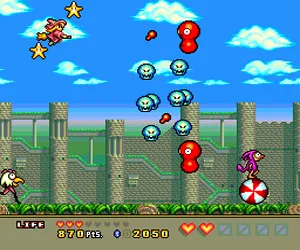
Magical Chase is a horizontal-scrolling shooter that landed on the TurboGrafx-16 in North America during July 1993, after originally hitting shelves in Japan two years earlier. Quest Corporation handled the development, while Turbo Technologies Inc. took care of publishing on this side of the Pacific. It's one of those colorful shooters that feels a bit lighter in tone than something like R-Type, thanks to its witch-and-fairy theme.

The player takes control of Ripple, an apprentice witch who accidentally lets a bunch of demons loose from a forbidden book. She's joined by her star maiden friends Topsy and Turvy as she flies through stages shooting enemies and dodging obstacles. The core loop is straightforward: move left or right, fire at anything hostile, collect power-ups to upgrade your shot, and face a boss at the end of each level. There's no complex scoring gimmick here, just old-school shooting action with a charming aesthetic.

Today, Magical Chase is remembered more for its rarity than its innovativeness. The North American release did not sell in huge numbers, which makes the cartridge a sought-after collector's item. As a game, it's a solid, if not groundbreaking, shooter that fits neatly into the TurboGrafx-16 library alongside other horizontal blasters. If you enjoy cute-'em-ups like TwinBee or Cotton, this will feel familiar, though it never quite reaches the polish of those series. It's worth a play for the visuals and the historical curiosity, but don't expect anything revolutionary.

How to Play Magical Chase (USA) Online

Getting started with Magical Chase means understanding Ripple's basic movement and shooting. Press the S key (B button) to fire your projectile, and use the arrow keys to move Ripple around the screen. The game scrolls horizontally, so you'll need to keep an eye on enemies coming from both the front and behind. As you defeat enemies, they sometimes drop power-up icons that upgrade your shot or give you extra lives.

A key mechanic is the ability to collect star-shaped items that fill a meter near the bottom of the screen. When that meter is full, pressing the X key (A button) triggers a screen-clearing bomb attack. Timing these bombs is crucial during boss fights, where patterns can get hectic. The star maidens Topsy and Turvy follow Ripple and provide additional firepower, but they are not separately controlled.

If you are playing the USA version, all menus are in English, so navigation is straightforward. Just select "Start" from the title screen using the Enter key, and you'll be dropped into the first stage. There is no difficulty selection, so it's a direct arcade-style experience. The game is forgiving early on but ramps up later, so don't be shy about using continues when you run out of lives.

Magical Chase (USA) Keyboard Controls

Controls

  • Arrow Keys: D-Pad / Movement
  • X: I button
  • S: II button
  • Enter: Run / Start
  • V: Select

Frequently Asked Questions

Is there anything iconic or memorable about Magical Chase?
The game is best known among collectors for its extreme rarity in North America, with only a limited number of copies released. Its bright, cute art style and witch protagonist make it stand out in a genre often dominated by gritty sci-fi ships. That said, it never became a household name even among shooter fans.
Does Magical Chase have a multiplayer or co-op mode?
No, Magical Chase is strictly a single-player experience. There is no option for a second player to join, nor any competitive versus mode. You are flying solo as Ripple throughout the entire adventure.
Is Magical Chase exclusive to NEC TURBOGRAFX-16 or did it appear on other systems?
It originally debuted on the TurboGrafx-16 (and its Japanese counterpart the PC Engine) in 1991. A Windows version was released in 1998, followed by a Game Boy Color port in 2000. So while it started on NEC hardware, it later reached other platforms.

Comments (0)

    More Shooter Games