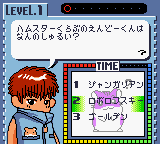
The game loads when you press Play · press “Play Now” inside the game if it asks.
Hamster Club - Oshiema Chuu (Japan)
Hamster Club - Oshiema Chuu
Inside Hamster Club - Oshiema Chuu
- Game Boy Color
- Simulation
- 5· 0 votes
Hamster Club - Oshiema Chuu is a Japanese-exclusive Game Boy Color title that landed in the late 1990s, right when virtual pet games were everywhere. It's a simulation game centered around caring for a hamster, though the exact developer or publisher isn't widely documented. The cartridge came out only in Japan, so anyone outside that region has to import or play it through emulation today.
The core activity is looking after a digital hamster: you feed it, clean its cage, play mini-games, and monitor its mood and health. The interface is entirely in Japanese, so navigating menus without knowledge of the language can be tricky, but the basic care routines are intuitive. You manage a schedule of activities, and the hamster responds to how well you treat it over time.
It's a niche piece, mostly interesting to collectors of Game Boy Color simulation games or anyone nostalgic for the wave of virtual pets that flooded handhelds in the late 90s. Compared to bigger names like Tamagotchi or Nintendogs, it's a simpler, more focused experience. If you enjoy slow-paced pet care and don't mind the language barrier, it offers a quiet, charming loop that holds up for short sessions.
The core activity is looking after a digital hamster: you feed it, clean its cage, play mini-games, and monitor its mood and health. The interface is entirely in Japanese, so navigating menus without knowledge of the language can be tricky, but the basic care routines are intuitive. You manage a schedule of activities, and the hamster responds to how well you treat it over time.
It's a niche piece, mostly interesting to collectors of Game Boy Color simulation games or anyone nostalgic for the wave of virtual pets that flooded handhelds in the late 90s. Compared to bigger names like Tamagotchi or Nintendogs, it's a simpler, more focused experience. If you enjoy slow-paced pet care and don't mind the language barrier, it offers a quiet, charming loop that holds up for short sessions.
GAME INFO
- Platform
- Game Boy Color
- Genre
- Simulation
- Players
- 1
- Region
- Japan
How to play Hamster Club - Oshiema Chuu online
Start by powering on the game. The title screen appears in Japanese; press Start (Enter) to begin. The main menu offers several options, likely for starting a new game or loading a save. With no English translation, you'll need to experiment or look up a guide for menu navigation. Typically, the top option starts a new game.
The game places you in a hamster room. Use the D-pad to move a cursor or select items. The core loop is checking on your hamster's needs: a food bowl, water, cleanliness, and attention. Icons around the screen indicate status. Press the A button (X key) to interact with objects. Mini-games might appear to raise happiness. The game saves progress automatically or via a menu option, likely using battery backup common for GBC cartridges.
If you get stuck, the two most important buttons are A (confirm) and B (cancel). The Select button often opens a submenu. Without Japanese knowledge, focus on trial and error. The hamster's face shows its mood, and a chart or meter might track health. Keep the basics covered, and you'll figure out the rhythm.
CONTROLS
Controls
- Arrow Keys: D-Pad / Movement
- X: A button (jump / confirm)
- S: B button (run / attack / cancel)
- Enter: Start / Pause
- V: Select
Hamster Club - Oshiema Chuu FAQ
Can players save progress in Hamster Club - Oshiema Chuu?
Saving is handled through the game's internal battery backup, common for Game Boy Color cartridges. The save feature likely activates after key milestones or when quitting through the menu. Most virtual pet sims of this era include auto-save as well.
Is Hamster Club - Oshiema Chuu exclusive to Game Boy Color or did it appear on other systems?
This title only came out for the Game Boy Color in Japan. No ports or re-releases on other platforms have been documented. It remains a handheld exclusive.
In what year was Hamster Club - Oshiema Chuu originally released?
The exact release year is not widely documented in English sources. It falls into the late 1990s/early 2000s timeframe for Game Boy Color pet simulation games.
You may also like
All Game Boy Color games

GAME INFO
- Platform
- Game Boy Color
- Genre
- Simulation
- Players
- 1
- Region
- Japan
COMMENTS (0)
No comments yet. Be the first to share your thoughts.