The game loads when you press Play · press “Play Now” inside the game if it asks.
Panic !
Panic !
Panic !: SCD Puzzle
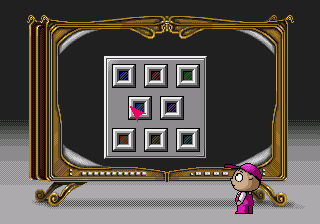
Panic! is a puzzle point-and-click game that landed on the SEGA CD in 1993, originally released by Sega and Office I in Japan and later brought to North America by Data East USA in 1994. It's an oddball title that leans heavily on weird humor and a labyrinth of buttons to press, all in collaboration with the Japanese theatrical group WAHAHA Hompo. The game stands out as one of the few SEGA CD titles to support the Sega Mega Mouse, which makes the point-and-click controls feel more natural than typical controller navigation.
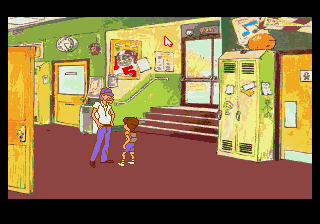
The core gameplay involves guiding a young boy named Slap, or his dog Stick, through a complex maze by pressing a seemingly endless array of on‑screen buttons. Each button press triggers some sort of reaction - opening a door, moving a character, or activating a trap - and you have to figure out the correct sequence to advance. It's less about speed and more about trial and error, with a heavy dose of absurdist humor woven into the puzzles. The labyrinth structure means you'll often backtrack and experiment, making it a slow but deliberate experience.
Today, Panic! is a curiosity piece for SEGA CD collectors, especially those who enjoy point-and-click adventures with a quirky, almost surreal tone. It doesn't have the polish of big-budget titles of its era, but its unconventional design and mouse support give it a unique feel within the SEGA CD library. If you're into obscure puzzle games that don't take themselves seriously, this one is worth a try - just be ready for a lot of button mashing and head-scratching.
The core gameplay involves guiding a young boy named Slap, or his dog Stick, through a complex maze by pressing a seemingly endless array of on‑screen buttons. Each button press triggers some sort of reaction - opening a door, moving a character, or activating a trap - and you have to figure out the correct sequence to advance. It's less about speed and more about trial and error, with a heavy dose of absurdist humor woven into the puzzles. The labyrinth structure means you'll often backtrack and experiment, making it a slow but deliberate experience.
Today, Panic! is a curiosity piece for SEGA CD collectors, especially those who enjoy point-and-click adventures with a quirky, almost surreal tone. It doesn't have the polish of big-budget titles of its era, but its unconventional design and mouse support give it a unique feel within the SEGA CD library. If you're into obscure puzzle games that don't take themselves seriously, this one is worth a try - just be ready for a lot of button mashing and head-scratching.
GAME INFO
How to play Panic ! online
Section 2 - Getting Started
When you first start Panic!, you'll see a title screen and then a menu where you can choose between controlling the boy Slap or his dog Stick. The game is entirely point-and-click: you move a cursor (using the D‑pad or the mouse if you have one) over various buttons and objects on the screen, then press the A button (X on keyboard) to interact. The labyrinth is presented as a series of static screens, each filled with buttons, levers, and cartoonish elements that respond to your clicks.
The core loop is simple: click buttons to open passages, move your character, or trigger events. There is no timer or scoring system - progress depends on figuring out the correct sequence of clicks. The puzzles are often abstract, so expect to try clicking everything. If you get stuck, there's no in‑game hint system, so brute force or a walkthrough will be your friend. The game supports save states via the emulator, but the original had no built‑in save feature - you had to finish the labyrinth in one sitting or remember where you left off.
If you're playing the English localization (North American release), menus and text are in English, so no language barrier. The controls are straightforward, but the sheer number of buttons can be overwhelming. Take it slow, click around, and enjoy the weird animations that play each time you press something. It's not a game you beat in an hour, but the bizarre charm keeps you exploring.
CONTROLS
Controls
- Arrow Keys: D-Pad / Movement
- X: A button
- S: B button
- Z: C button
- A: X button (6-button pad)
- Q: Y button (6-button pad)
- E: Z button (6-button pad)
- Enter: Start / Mode
Panic ! FAQ
Can players save progress in Panic !?
Panic! originally had no built-in save feature; you had to complete the labyrinth in one session. Emulator save states work around this, but the stock game expects a single continuous playthrough.
Is Panic ! considered easy to pick up or challenging?
It is challenging more due to trial and error than difficulty of execution. The puzzles are abstract and require clicking many buttons to see what happens, so patience and experimentation are key.
Is Panic ! exclusive to SEGA CD or did it appear on other systems?
Panic! was released on the SEGA CD in 1993 (Japan) and 1994 (North America). It later came to the PlayStation 2 in Japan in 2002, but never appeared on other platforms outside Japan.



COMMENTS (0)
No comments yet. Be the first to share your thoughts.