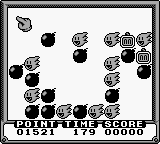
The game loads when you press Play · press “Play Now” inside the game if it asks.
Same Game (Japan)
Same Game
Getting to Know Same Game
GAME INFO
How to play Same Game online
Getting Started
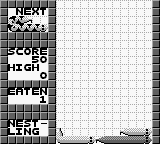
Upon starting Same Game, you will see a grid filled with small squares of different patterns (since the Game Boy screen is monochrome, colors are represented by distinct fill patterns). The goal is to clear the board by removing groups of two or more adjacent tiles that share the same pattern. Move the on-screen cursor using the D-Pad to highlight a tile, then press X (A button) to select it. Any connected group of the same pattern will disappear, and tiles above will fall down; empty columns will shift left.The game does not have a timer, so take your time planning each move. Single tiles that are left behind cannot be removed, so try to avoid isolating them. The screen shows your current score and the number of remaining tiles. When no more groups of two or more exist, the round ends and you can see your final score. All menus are in Japanese, but the gameplay is intuitive: simply press Start to begin a new game and use the D-pad to navigate the few menu options (usually just "Game Start" and "High Scores"). If you are unfamiliar with Japanese characters, look for the largest text at the top of the menu - that is typically the start option.
CONTROLS
Controls
- Arrow Keys: D-Pad / Movement
- X: A button (jump / confirm)
- S: B button (run / attack / cancel)
- Enter: Start / Pause
- V: Select
Same Game FAQ
Can players save progress in Same Game?
Same Game does not include a save feature on the Game Boy. Each session is self-contained and high scores are recorded only until the system is turned off. There is no battery backup or password system.
Is Same Game exclusive to Game Boy or did it appear on other systems?
Same Game originated on Japanese home computers like the PC-8801 and MSX, and later appeared on the Game Boy in Japan. It has since been ported to numerous other platforms, including mobile phones and modern compilations, but the Game Boy version is specific to Japan.
Is Same Game an official release, a fan hack, a prototype, or another kind of build?
This is an official commercial release from around 1990, published exclusively in Japan. It is not a hack, prototype, or fan-made modification - it is a legitimate retail Game Boy game.
COMMENTS (0)
No comments yet. Be the first to share your thoughts.